
Langara board keeps Paula Burns as president despite 92% non-confidence vote
Decision follows months of pressure from the faculty association as the college remains mired in financial crisis tied to the international student cap
By MILENA BAAK
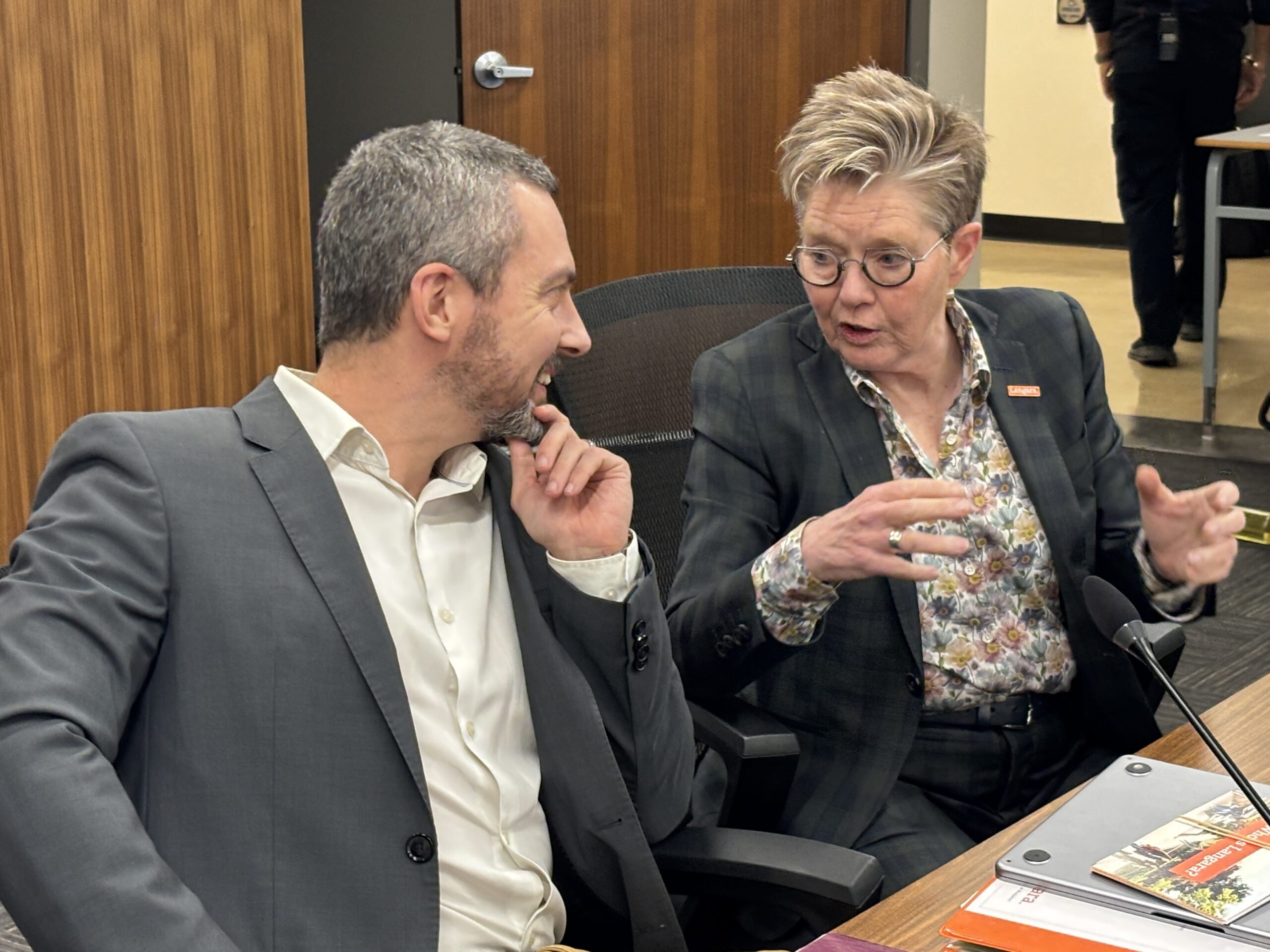
Langara College’s board of governors announced Tuesday that Paula Burns will remain as the college’s president and CEO, despite a 92 per cent faculty vote of non-confidence against her last fall.
The decision follows months of pressure from the Langara Faculty Association, which has argued the college remains “in crisis” and “still without a plan,” as enrolment declines and staffing reductions continue.
The board began a formal evaluation of Burns last fall under Policy 435, a process board chair Scott Murray said would assess whether the president is meeting strategic priorities and operating within board policies.
“The board of governors completed its independent review and confirmed that president Burns will continue in her role,” Murray said in a statement to the Voice. “The board’s decision was grounded in the need for stability during a period of uncertainty across the post-secondary sector.”
He pointed to the fact many colleges are facing a range of external pressures, adding that “at this moment the board believes continuity of leadership is important to keep the college operating smoothly and focused on its core mission.”
LFA president Pauline Greaves-Aylward said she was “incredibly disappointed” in the board.
“The ship is sinking. It has already hit the rocks, and we are drowning,” she said. “And instead of them trying to rescue the people, the students, the faculty, the CUPE members … they’re saying, let’s hold the course. We can’t hold the course. There’s nowhere to go but down. There’s nowhere below.”
During the board of governors meeting on Jan. 29, Michael Koke, Langara’s vice-president of administration and finance, told the board that the forecasted deficit had climbed to $32 million.
“You may not be surprised to notice that our assessed audit risk has risen,” he said.
The Voice reached out to the college to give Burns an opportunity to speak but was told she would “not be commenting at this stage.”
LFA stance
Greaves-Aylward has previously said the administration has not provided a credible stabilization plan that protects teaching and student supports. Addressing the board of governors at a meeting before its members went in-camera session to discuss Burns’ leadership and future at the college — Greaves-Aylward said faculty were concerned about the college’s long-term viability and how it would survive this financial crisis.
Burns rejected the suggestion that the college lacks direction, telling the board a “strategic framework” and “institutional recovery plan” are underway.
English professor Tanya Lewis, who attended the meeting as an observer, said what has been presented so far, amounts to “window-dressing” and described the strategy documents as “beige” and “generic.”
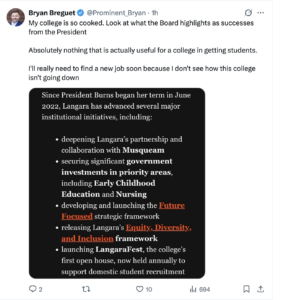
In an email to faculty explaining the board’s decision, Murray credited Burns with deepening Langara’s partnership with Musqueam, securing major government investments in priority areas such as early childhood education and nursing, launching the Future Focused strategic framework and the college’s equity, diversity and inclusion framework, and introducing LangaraFest — an annual open house aimed at boosting domestic recruitment.
Greaves-Aylward said many of the achievements Murray attributed to Burns were simply “concepts,” and not plans and that none of them would “rescue the reputation of Langara.”
“None of them will rescue the reputation of Langara, and none of them will succeed in providing any kind of sustainability,” she said.
“The board of governors is focusing on one person at the expense of the college and the integrity of the college,” Greaves-Aylward said. “They’ve decided that they’re going to continue to pay her to basically sit and do nothing.”
Reactions
After the decision was shared with faculty, response was swift from some who were waiting for the board’s decision.
Langara economics instructor Bryan Breguet quickly tweeted: “The leadership at my college is such that I genuinely expect us to go under. If you have a 30m deficit for one year and your response is ‘yeah but we did some good work on DEI’ … We’re cooked.”
Several instructors approached for comment did not want to be interviewed.
Non-confidence vote
The non-confidence vote last October came as Langara faced steep enrolment declines tied to the deferral government’s cap on international study permits in 2024.
In an August email to faculty, Burns said the college had approximately 2,400 fewer students, and overall enrolment was down almost 20 per cent from two years earlier. The LFA has said that more than 25 per cent of its membership has lost work since fall 2024.
Burns has been president and CEO of Langara since June 2022. She was previously the president at Alberta’s Lethbridge College where she had two votes of faculty non-confidence against her leadership in 2015 and 2016.
“Our priority remains supporting students — ensuring they can continue their studies, access the services they rely on, and graduate with clear pathways to university transfer or career-ready academic credentials,” Murray wrote in his statement.
This story will be updated with reaction.
Comments are closed.