
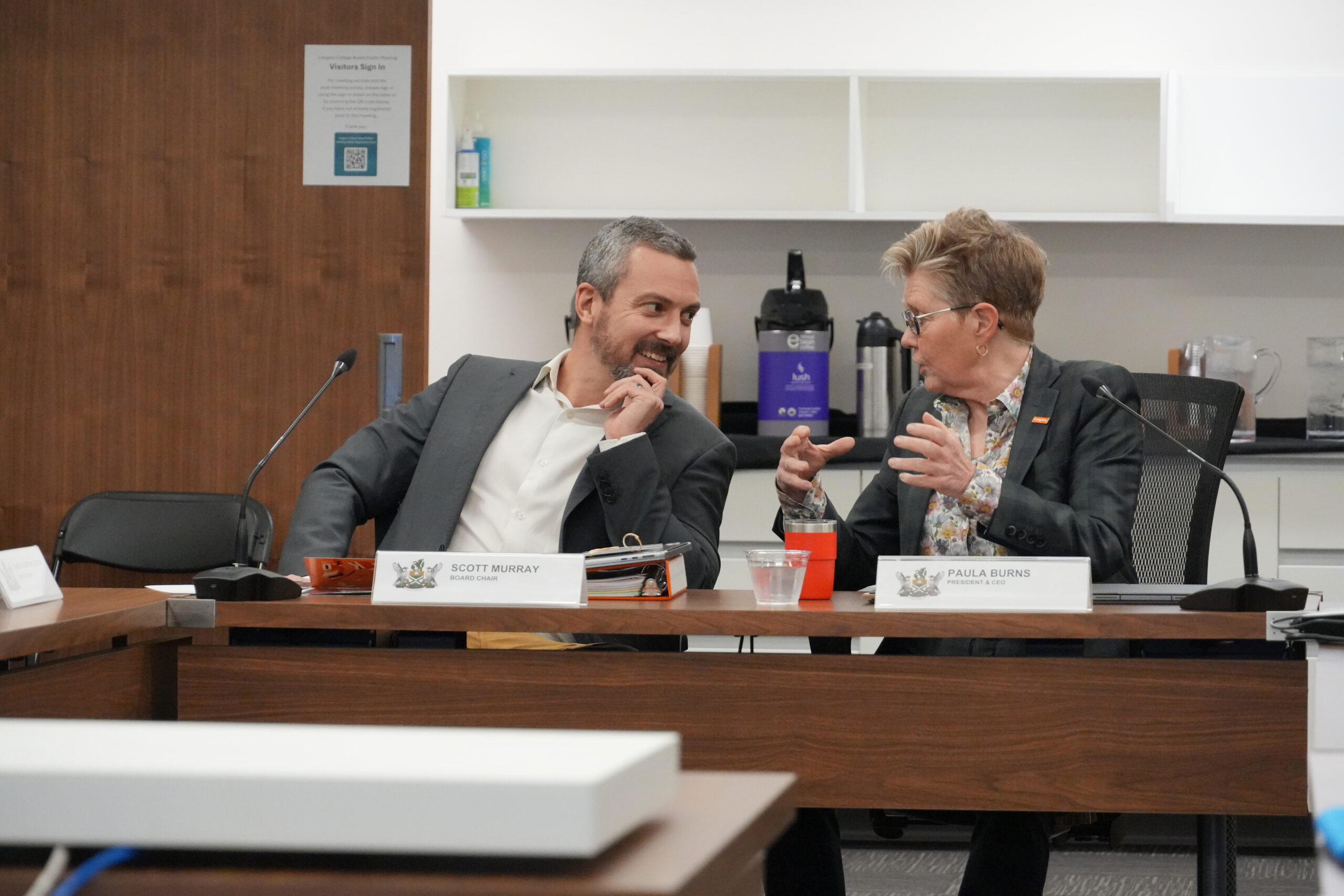
Faculty describe ‘climate of fear’ after Langara board retains Paula Burns despite 92% non-confidence vote
Instructors worry speaking out could affect jobs and opportunities now that Burns has the board’s backing
By OKSANA SHTOHRYN
Langara faculty say a climate of fear is growing on campus since the college’s board of governors announced it will retain president and CEO Paula Burns despite a 92 per cent faculty vote of non-confidence last fall.
Since the board’s announcement Tuesday to keep Burns in place, many faculty have declined to be interviewed by the Voice, citing fears of retaliation against themselves or their departments now that Burns has the board’s backing.
Nina Winham, who has been an instructor with the Langara school of management for the past decade, lost part of her work this year and expects to lose all of it as of September. She said the board’s decision has created a “chill factor.”
“I certainly have heard from some colleagues that they feel like speaking out could cause retribution,” she said.
‘Uncertainty and fear’
In an email sent to faculty to announce the decision, board chair Scott Murray said the reason for keeping Burns as president and CEO was to “continue to provide stability for the college during this turbulent time in the post-secondary sector.”
“I mean, we can have stability and still sink,” Winham said, alluding to Langara Faculty Association president Pauline Greaves-Aylward’s analogy in the media that the college was a sinking ship.
“As faculty, we’ve lost confidence in the board,” Winham said. “When you lose faith in a governing body, it creates more uncertainty and possibly fear.”
The email highlighted Langara’s advancements since Burns began her term in June 2022, including deepening partnerships with Musqueam, securing government investments, launching the college’s Future Focused strategic framework and LangaraFest, a domestic student enrolment open house.
“For two years, we’ve been in an impending predictable crisis about how we’re going to keep the lights on,” Winham said. “None of what’s in that list is what actually keeps the lights on.”
The board email offered no specific performance criteria or benchmarks going forward.
Many faculty said the email sent to faculty to announce the board’s decision felt celebratory and dismissive of their concerns.
Tanya Lewis, an English instructor, said the faculty’s concerns were “completely brushed aside and not taken into consideration.”
Concerns about lost opportunity
Winham said faculty were worried about speaking out now that Burns has the board’s backing. She said having a union in theory provides freedom of speech protection — but not entirely.
“You can’t be fired when you speak out,” she said. “However, could your work be altered? Could you be passed over for opportunities?
“It’s just like fear of judgment, fear of people holding that against them.”
Independent governance questioned
Some faculty questioned why communications from the board of governors are funnelled through the college communications staff, who are Burns’ direct subordinates.
“We don’t feel confident that the board is actually doing its job as an independent governance body with strong oversight,” Winham said. “Rather, we feel like they are too close to the senior administration and therefore we don’t feel that we can speak freely.”
The college board of governors is an independent body, mandated by provincial legislation, that is separate from the college’s management and oversees the school’s direction and finances. It also hires, evaluates and can dismiss the president, who reports to the board.
A college spokesperson said in a written statement to the Voice that the strategic communications and marketing department provides “administrative and distributive support” for both the board and administration but does not author board positions or speak on its behalf.
However, when the Voice contacted the college’s communication department to ask for a response from Burns to faculty who say they fear speaking out since the board’s decision, and what assurances can she give them, it received a statement from board chair Scott Murray instead.
“The board and president value the input received from faculty, staff, and students and will continue to listen to and work with the Langara community to achieve the core mission of the college.”
Murray said the board recently established an institutional sustainability task force that includes board members elected by staff, students and faculty to provide oversight on the college’s recovery plan, and “other activities aimed at the long-term sustainability of the college.
“Through this process, we will continue to encourage open and constructive dialogue,” Murray wrote.
When the Voice asked whether it would get a separate comment from Burns, it was told the chair’s statement would be the only one provided.
Non-confidence vote
The October non-confidence vote cited enrolment declines largely driven by federal caps on international study permits, a deficit that has doubled from $16 million to $32 million in six months, and 219 instructors who lost work.
Langara College student Jelyn Wang said the situation is unfair to faculty.
“It’s just unfair for the teachers who are getting laid off and those who have to keep working with [Burns] now, knowing that she probably doesn’t feel anything about this.”
This is such strong journalism, great article 👏
Academic institutions depend on trust and open dialogue. When that breaks down, everyone loses—faculty, students, and the institution itself. I hope the new task force will actually listen to these concerns rather than just going through the motions.
That was really insightful!