
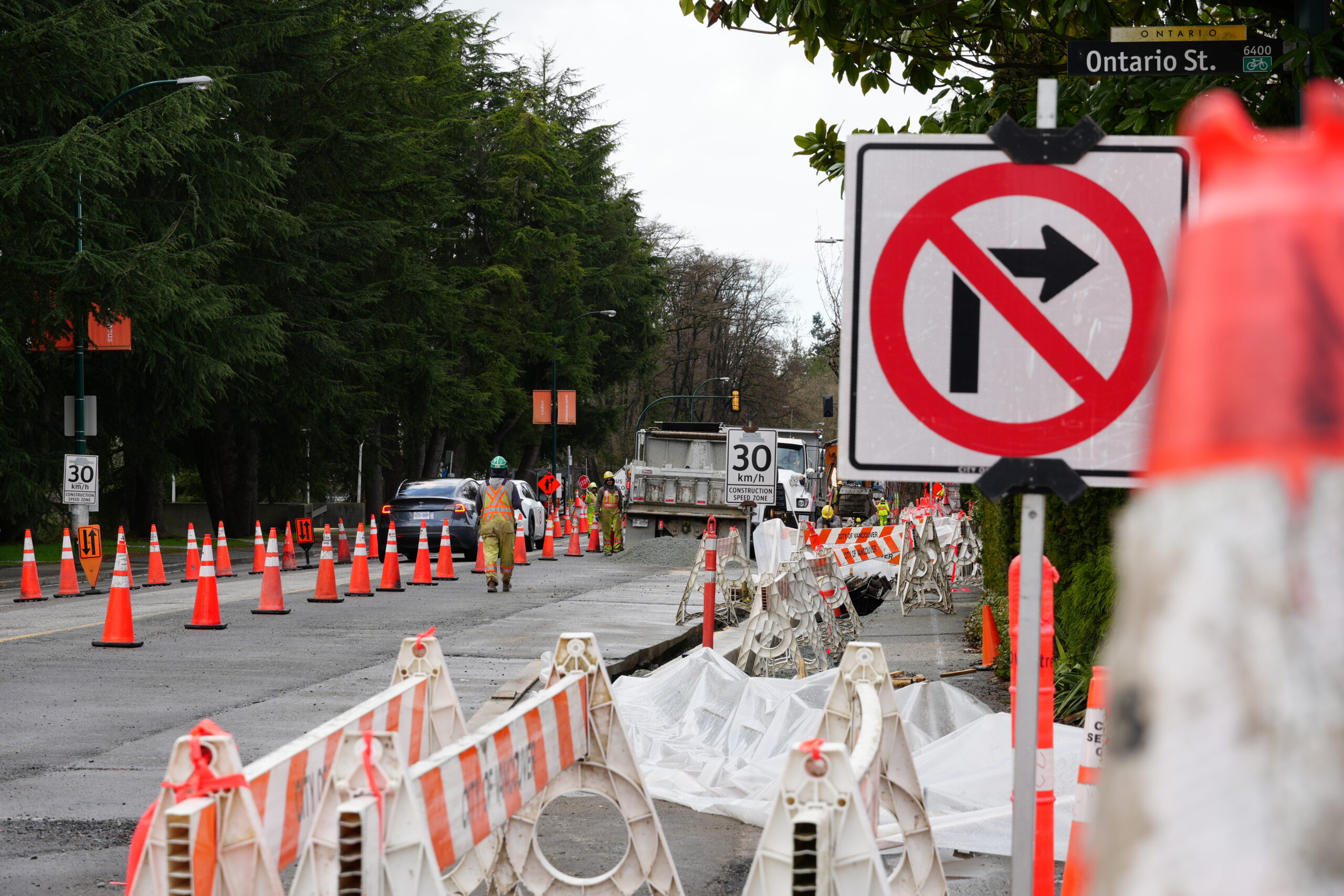
Travel times and local parking interrupted by construction on 49th Avenue
With construction rapidly increasing, residents say the city chose the "laziest" option when it comes to removing street parking
By VALENTINA BARRERA
TransLink plans to speed up Route 49 by adding bus lanes and removing stops, but residents say they’ll lose the street parking they rely on along 49th Avenue.
The proposal affects 28 stops between Crown Street and Boundary Road. Route 49 carries 8.5 million trips annually, yet one in four buses run off schedule.
Carol Kong, assistant branch manager of transportation design for the City of Vancouver, said in a statement to the Voice that the project aims to improve bus reliability and service.
“The planned bus improvements on 49th Avenue are delivered in partnership with TransLink,” Kong said. “Businesses, residents, and transit users were able to provide feedback via surveys, email, and in-person meetings.”
Some residents say consultation has been insufficient.
“Devastated” by lack of consultation
Ajay Brach’s elderly parents live along the route. “They haven’t consulted anyone. They haven’t asked anyone for their feedback,” he said.
Brach said his parents were struggling with the changes.
“I think they’re quite devastated,” he said.
Brach said visiting his parents often requires parking several blocks away.
“Some of us have kids. And then we have to walk with, imagine, three or four kids, several blocks to visit them. So it just kind of deters us [from] wanting to go to visit them.”
Brach said the plan ignores other possible solutions.
“There’s tons of options … but they chose to do the laziest, in my opinion,” he said.
All door boarding is a “no-brainer”
Transit advocates say all-door boarding could improve travel times without disrupting the neighbourhood.
“It makes transit faster,” said Denis Agar, executive director of Movement YVR, a Vancouver transit advocacy group. The group launched a petition for all-door boarding in early March.
TransLink’s current policy limits all-door boarding to RapidBus routes and several high-volume routes, including the 145, a shuttle to SFU that has used all-door boarding since 2002.
“We are planning to review our all-door boarding policy in the future, but no details are available at this time,” said TransLink media relations in an email to the Voice.
Agar said shorter boarding times could also lower operating costs.
“Time is money. The longer a bus route takes, the more it costs to run,” he said. “We think all-door boarding can save about $15 million a year.”
Movement YVR said the estimate is based on a three per cent travel time reduction using TransLink service hours and operating costs, for about $15.4 million in annual savings.
Vancouver’s neighbour, Seattle, Wash., is switching to all-door boarding system-wide this month.
All-door boarding also reduces crowding, Agar said.
“When passengers board only at the front, buses get packed near the driver while space remains at the back,” he said. “With all-door boarding, you can have people board evenly throughout the bus. It’s really such a no-brainer.”
Student transportation disorganized
Riders say crowding and delays are already part of their commute.
“It’s busy. It’s fast, but sometimes it’s too full,” said Ngawang Eden Gyeltshen, a first-year health science student at Langara. “Sometimes they just pass by you because it’s full.”
Jaiden Ranta, a first-year general science student at Langara, said front-door boarding doesn’t always work.
“The door opens and everyone just floods in,” she said.
Comments are closed.