
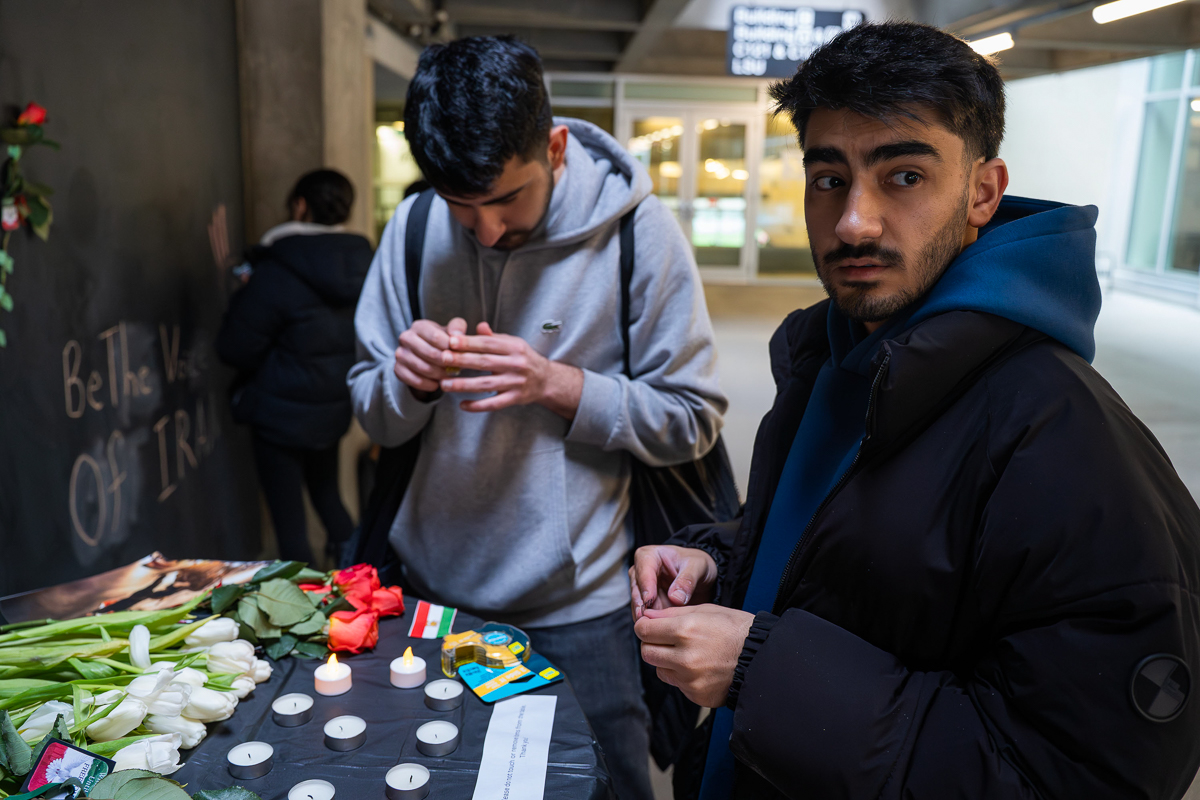
As war intensifies, Iranian students say they need more support from Langara
Counselling department prioritizes appointments for those in "acute distress"
By LIAM ROBERT SCOTT
As the conflict involving Iran intensifies, Iranian students say support at Langara College has been insufficient, despite the college’s assertion that it has prioritized counselling and outreach.
The recent military attacks by the United States and Israel on Iran has renewed calls for better support for Iranian students at the college.
On Feb. 28, the United States and Israel began major coordinated air and missile strikes on Iran. The attack came after the Iranian government carried out mass killings of its citizens and imposed an internet blackout in the weeks prior.
War wages on students
The chaos from back home has affected Iranian students at the college, many of whom have family living there.
Ryan Sadeghi, a second-year computer science student from Iran, said the turmoil has made it difficult to focus on school while worrying about family back home.
“I just couldn’t stop looking at the news whenever I wanted to start studying,” he said. “The extent of the killing was so much.”
After the two-week blackout ended, his mother reached him by phone.
“I just broke down on the phone with her,” Sadeghi said.
Shadab Mahavarpour, the president of the Langara Persian Club and second-year biology student, said the club is supporting Iranian students like Sadeghi, but has encountered roadblocks.
“We reached out to the counselling department to arrange a group counselling session for our students,” she said. “They told us that they are short-staffed and they cannot have a group counselling session.”
Mahavarpour said a recent meeting with college administrators and Langara Global, which assists international students, improved the club’s outlook.
Persian club member Shahrad Nezamolmolki, a second-year general science student, is less optimistic about the club’s meeting with the college.
“In the meeting, it’s always words that are convincing,” he said. “But then again, one week passes, two week passes, and then you see none of that coming to reality.”
Nezamolmolki also said some students have experienced indifference from instructors.
He said a fellow Iranian student left class after learning a friend had been shot.
He said the student was later told it was not a sufficient reason to miss coursework.
“I feel like Langara College can do much more to help students,” Nezamolmolki said.
College statement
The Langara communications department initially said it would provide somebody to interview about the student supports, but later said they “were not able to arrange an interview at this time.”
In an emailed statement responding to questions from the Voice, the communications department said the college’s counselling services have prioritized appointments for students experiencing acute distress related to events abroad.
The statement said that over the past weeks, Langara Global and student services have connected directly with student leaders, “including representatives of the [Langara Persian Club], to better understand concerns and ensure supports are accessible.”
“We know that the situation in Iran has been deeply distressing for many Iranian students, faculty, and staff, and when unrest affects regions where members of our community have close ties, our focus is on ensuring they feel supported, heard, and connected to appropriate resources,” the statement said.
It said Iranian students could access free counselling from the college as well as external 24/7 mental health supports Empower Me and Here2Talk. International students can also connect with their international student coordinators for guidance, referrals and support navigating academic or personal accommodations where needed.
“Our priority is student wellbeing, and we remain committed to fostering a campus environment grounded in care, respect, and support during times of global uncertainty,” the statement said.
Expectations of help
Students should not bear the consequences of crises beyond their control, said Atif Kubursi, a professor emeritus of economics at McMaster University and former acting executive secretary of the United Nations Economic and Social Commission for Western Asia.
“The faculty, the society, the universities have some moral obligation to tend over these people, to see how they might really help them deal with the deprivation they’re feeling,” he said.
The renewed strikes and a fresh internet blackout in Iran have left Nezamolmolki balancing cautious hope with renewed anxiety.
“There is another blackout… it’s been more than a day that I do not have any connections with my friends and family,” he said. “If you cannot connect to them, the stress just starts to escalate.”
VIDEO: Langara College student, Shahrad Nezamolmolki, talks about his firsthand experience living in Iran and explains how the government has been handling the situation.
Comments are closed.